fruits of my love
A sweet serving of love, family, and one of your five a day.

My love for fruits is a love that transcends beyond any boundaries and limits. I say that if you want an easy way to see me happy; hand me a piece of fruit and I guarantee a smile will soon appear on my face. Any time of year and in any country, you will find me seeking out the best fruits (no matter the size, shape, or popularity) and/or trying a variety of fruit-related foods (smoothies, juices, etc). My love is so intense that I often get asked why; why am I so passionately obsessed with something so normal and conventional in my world. Usually, I answer that it’s because of how sweet they can be. No one questions it, but I’m the only one who understands that there is a deeper meaning behind the word “sweet”.
I vividly remember fruits playing a significant role in my upbringing. For my family and many families like mine, fruits were our unspoken language. In our society, we talk about non-verbal cues as being something within the body: eye contact, tension in the shoulders, posture, etc. But for us what couldn’t be said aloud were instead demonstrated via impeccable peeling and ripe, in-season produce. Gently packed in a weird styrofoam-lattice wrapping that I would play with, this seemed to be the only way we could convey our affection. And maybe more…
I could never imagine the influence fruit would have in my life. Apples were cut in perfect slices and served on a plate, a mini fork accompanying it to ensure my fingers wouldn’t get sticky. If they were for lunch or snacks, they’d be soaked in lightly salted water to keep them crisp, white, and sweet. Sometimes, if I was lucky, the apples would be cut to resemble a bunny. Kiwis— always the golden kind because they were sweeter — felt like little round slices of sunshine. Persimmons had an indescribable texture and flavor, but still provided great satisfaction. Strawberries were little gifts from heaven, mangoes were juicy and tasted of paradise, lychees were addictive and floral, peaches were tickled in a blush pink with a fragrant white interior, and watermelons were refreshing despite the warnings about their seeds, and oranges made me feel mature as I could peel the small ones by myself. I gave meaning to each fruit, gave them substance behind every unsaid I love you.
I feel another unspoken pressure; my family’s dream of my success. I do dream for my own future, letting my heart and mind take me to the stars. Yet, I can’t let my own imagination be in control all the time. I work maniacally, knowing that time is finite and that tomorrow isn’t guaranteed. I feel conflicted about dreaming big, as the stakes have always been stacked up against me. I reassure myself that I’m lucky to dream and I dream because a part of me knows I may be able to accomplish them, though I’m only cautiously optimistic. I’m allowed to be passionate about many things, I may one day prove the doubts other people casted on me as wrong. I hope that one day, these dreams will bring me joy and make my family proud. Pride and happiness; the greatest gifts I could bestow. I do everything I can to get closer to the impossible, so much so that I don’t even notice my mother sneaking in to set down a plate with pieces of the sweetest fruit on it, dropping off a small fruit fork and a napkin before quietly taking her leave.
I feel like I’m drowning; I can’t breathe. I’m in pain, but I can’t seem to express it. I silently cry, not wanting to wake up those peacefully dreaming on the floor above me. When I’m awake or trying to function in the world, I snap or isolate myself. I convince myself that I’m protecting others by doing that, maybe protecting myself; I don’t necessarily believe it though. People remark that they’re losing me. They watch as I slip away; I feel too exhausted to come back sometimes. We as a family always struggled to verbally express our inner emotions; love and pride were usually the hardest, but now sadness seems to be overtaking it all. How do you even describe emptiness? Nothing. Weapons of words, often the only times where any one of us is verbally open. We don’t speak for days, barely acknowledging each other’s existence. Tense, waiting, surviving. We don’t say our apologies, too stubborn to admit we’re soft. Soft was the same as weak; I’m already weak. It isn’t until one day, when we slowly start drowning again, that my mother walks in— not knocking, as usual— and shows me the nostalgic apple slices shaped like bunnies that I feel myself breaking.
I watch as the people around me receive gigantic fruit baskets (wicker basket base; plastic wrapping and a bow to complete the look) and Edible Arrangements (unripe melons and pineapple turned into adorable flowers). Gestures of gratitude or proclamations of love; pure intentions for the most part. Maybe it’s from a prospective colleague we interviewed. Maybe someone has a secret admirer. Once in a while, one with the wrong message (someone trying to look better than they are, someone trying to make up for an inexcusable mistake, someone…) falls through; the fruits either not having any flavor or rubbing wealth in our open wounds. Regardless, each one of these gifts make an entrance of their own. And while others swoon over the extravagance, I can’t help but guiltily think to myself, those expensive displays don’t hold the same sentiment as bright red strawberries on a chipped china plate.
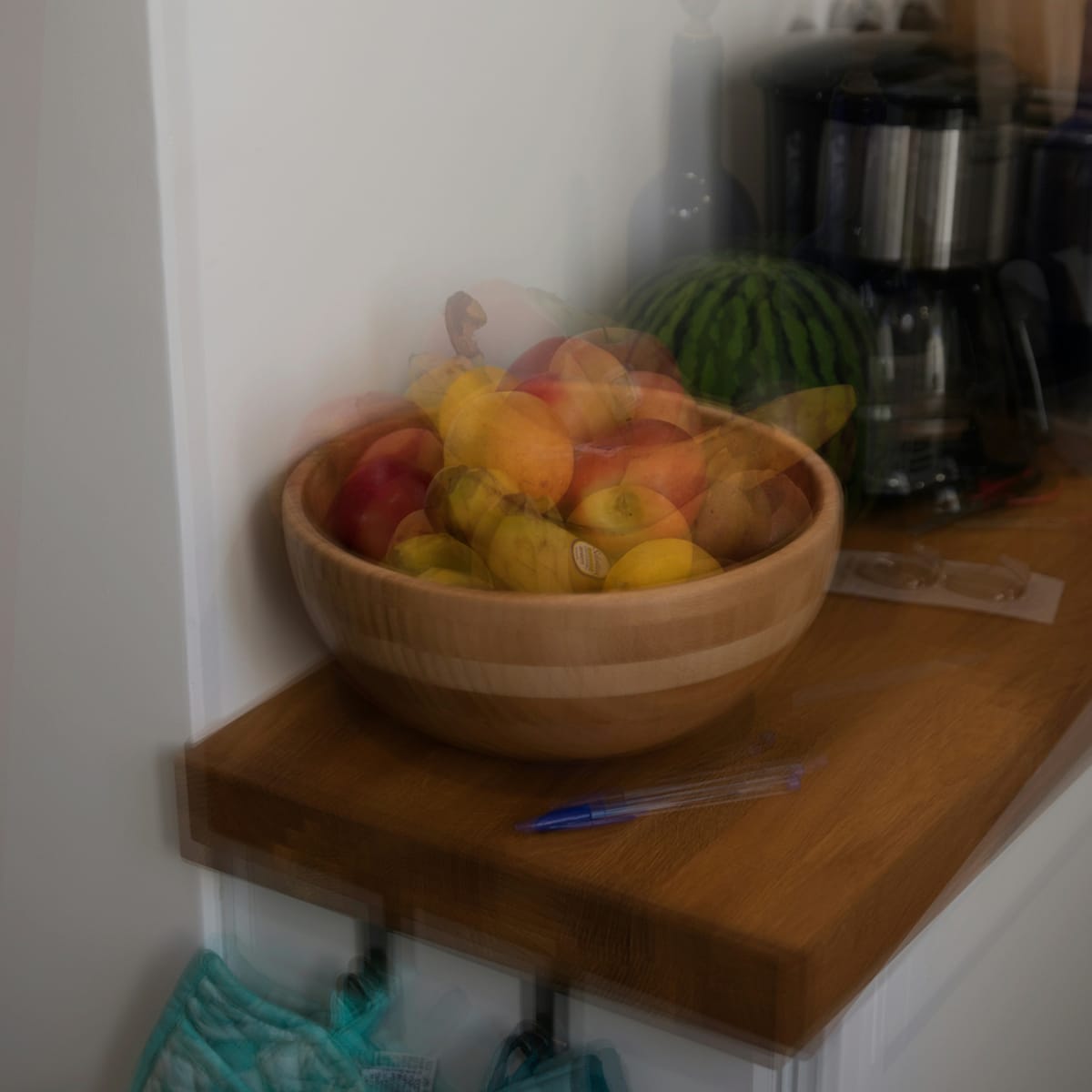
I find myself becoming a mirror of my mother and other members of my family. I allow myself to get lost amongst the fruits in a market. I lose track of time as I scan each fruit to determine which ones are in the best condition. I consider which fruits are in season, which ones are on sale, and which ones I truly just crave. I pack them gently into my bags, treating them like irreplaceable treasures. I leave some on my kitchen counter, promising that I will be patient and making them a temporary decoration amongst the bottles of sesame oil and dashi stock. Some are stored in my fridge, nestled next to containers of Japanese pickles and tupperwares of leftovers.
I never seem to have enough time, so I bite into apples with the peel on or scoop kiwis out of their skin with a spoon. I know how to properly use a knife, but my exhaustion wins most of my battles and I take shortcuts. But when my loved ones — friends, family, whoever — come over, I welcome them with those grapes that shine and taste like candy, or the snow white slices of the juicy Asian pears that burst when you bite into them. My cutting and plating techniques are nowhere near perfect as my mother’s, but it is enough to satisfy those who want something sweet. I watch as they savor each bite of the fruit, some remarking that it reminds them of home.
I embrace my family members; the wrinkles next to their eyes have become more prominent, their hands still warm, though their grip is weaker than it once was. Thankfully, their eyes still sparkle when they say “Long time no see” and “Welcome home”. I tell myself that they sparkle with happiness; they may argue they glisten with a bittersweet glow. They tell me to come in, leave my shoes at the door, slip on the indoor slippers they bought me years ago, and take a seat at the table. The chair is unbalanced, and the cushion on it has sunken in so much that it almost feels redundant. They inquire about my life and ask me to tell them every detail, all while they wash a recently ripened fruit. Fresh and sweet. They delicately peel the skin, their shaky hands still able to perform an elegant act. It’s beautiful. Slice it into slivers, water droplets still visible on some. They plate it in such a simple way, but it looks like artwork in my eyes. Then, they place it in front of me, set the small metal fork next to it, and squeeze my hand.
It feels like home.
It feels like love.
Author: Ayako Kiyota
Editors: Charlotte Y., Luna Y.
Image source: Antoine Boissonot, Unsplash